
The rapid adoption of generative artificial intelligence has altered the digital landscape, making website creation faster and lower cost than ever before. However, this accessibility introduces a distinct commercial threat: The dangers of AI Slop on Business Website Design. When business owners rely on unverified AI website builders to produce automated page layouts, stock headlines, and synthetic imagery, the resulting digital presence often lacks strategic direction, technical accuracy, and legal compliance. While AI tools accelerate execution, publishing raw output without expert oversight produces generic, untrustworthy digital assets that turn away high-value prospects.
Key Takeaways
• Authenticity Outperforms Automation: AI-generated content and templates provide speed, but generic messaging weakens brand differentiation and fails to build trust with high-intent decision-makers.
• Search Quality Matters: Search engines focus on content usefulness and originality rather than production methods; publishing low-value, scaled AI pages risks severe visibility drops under spam policies.
• Accessibility Requires Human Oversight: Automated site builders often create structural, visual, and navigation flaws that fail accessibility standards, isolating prospective clients and increasing legal risks.
• Regulatory Compliance Is Non-Negotiable: In South Africa, unverified AI claims or mismanaged customer forms can trigger consumer protection violations and data privacy breaches.
• Human Strategy Is Indispensable: AI functions best as an assistant for ideation and structure, while positioning, brand identity, and quality assurance require human direction.
Table of Contents
• Defining AI Slop and the Appeal of Automated Web Design
• How Generic AI Output Undermines Branding and Conversions
• Technical and Search Risks: SEO, Performance, and Accessibility
• Legal, Compliance, and Trust Vulnerabilities in AI Content
• Human-Driven AI Workflows: Strategic Quality Control for Businesses
• Frequently Asked Questions About AI Slop in Website Design
Defining AI Slop and the Appeal of Automated Web Design
What AI Slop Looks Like on Commercial Websites
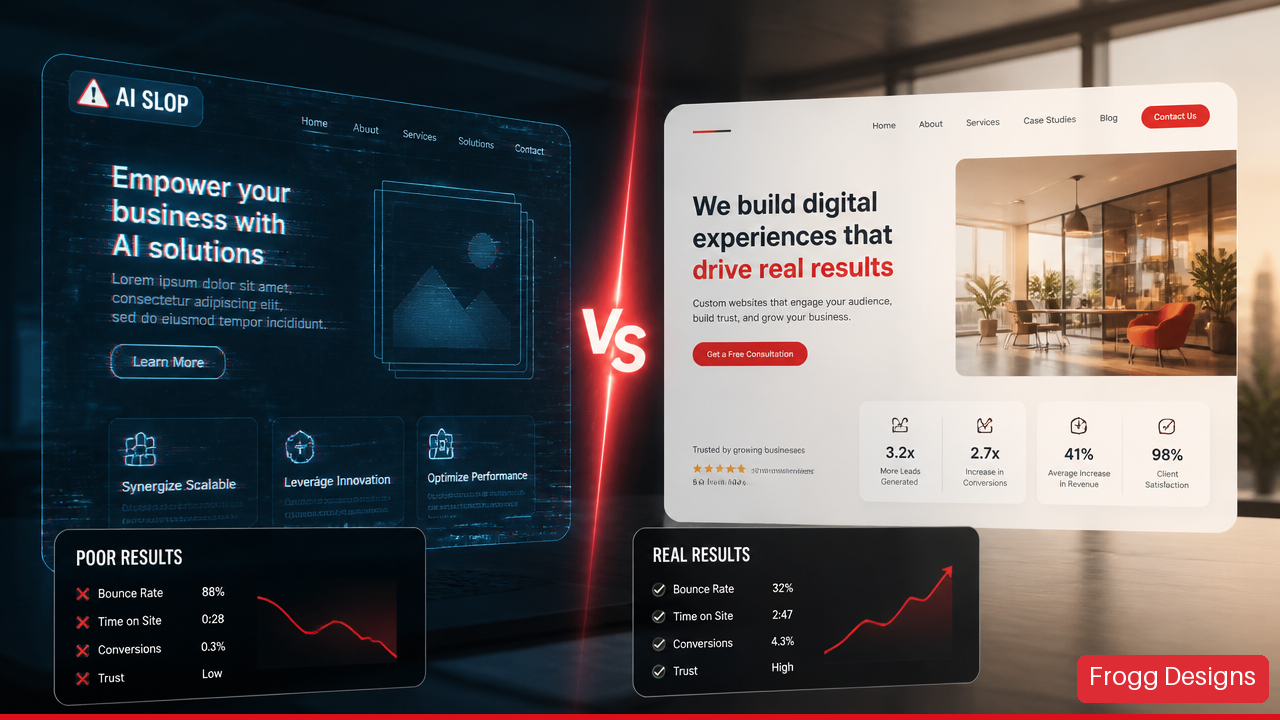
AI slop in web design refers to low-effort, mass-produced digital content generated by automated systems and published without adequate human judgment, strategic alignment, or quality control. Although synthetic output may look complete at first glance, a closer examination reveals clear patterns of shallow execution. Recognizing these warning signs is crucial before unedited pages harm your commercial reputation.
Common visual and linguistic markers of AI slop include:
• Vague, Interchangeable Headlines: Phrases like “Innovative solutions for your unique business growth” or “Empowering your digital future through excellence” that fail to explain specific services.
• Predictable Layout Patterns: Repetitive grid layouts, generic three-card feature blocks, and uniform section dividers that mimic thousands of automated sites.
• Synthetic Visual Artifacts: AI-generated hero images featuring unnatural lighting, distorted hands, impossible architectural geometry, or disconnected stock themes.
• Unsubstantiated Claims and Testimonials: Marketing statements boasting “unmatched industry excellence” alongside manufactured client quotes that lack verifiable proof.
• Illogical Keyword Stuffing: Web copy tailored strictly to hit search engine targets rather than providing practical answers to user questions.
• Broken Functional Workflows: Form fields, modal pop-ups, or navigation buttons that visually appear complete but fail during actual user testing.
Polished visual presentation does not equal strategic value. The defining attribute of AI slop is not its visual surface, but its complete absence of human experience, original insight, and brand positioning.
Why Businesses Fall into the Automated Design Trap
We recognize why business leaders find automated website builders tempting. The appeal centers on convenience, rapid turnarounds, and immediate cost reductions. Small business owners and marketing directors facing tight timelines often see AI as a shortcut to launching new landing pages or complete site overhauls.
Key drivers of automated tool adoption include:
- Accelerated Production Cycles: Generative platforms assemble full page layouts and draft descriptive text in minutes.
- Reduced Upfront Costs: Automated builders offer low monthly subscriptions, avoiding initial design investments.
- Low Barriers to Entry: Drag-and-drop AI environments allow non-technical staff to launch pages without coding expertise.
- Instant Layout Suggestions: Built-in prompts quickly draft content schemes, navigation trees, and color palettes.
High-Cost Pitfalls Behind Rapid AI Site Generation
The fundamental problem with unedited AI web assembly is that it generates an asset that resembles a functional business website long before it is commercially ready. Speed at launch often translates into long-term friction. When evaluating the pros and cons of using AI to write blog posts or design landing pages, decision-makers must weigh short-term speed against long-term brand equity.
When a site relies entirely on machine-generated patterns, it sacrifices market positioning. A platform designed to predict the statistically most likely next word or layout element will always yield average, consensus-driven design—the exact opposite of distinct market differentiation.
How Generic AI Output Undermines Branding and Conversions
Generic Visuals and the Loss of Brand Differentiation
Generative AI platforms operate by analyzing patterns across millions of existing websites. Consequently, when an AI website builder designs a page, it defaults to the most common visual choices found across its training data. This creates a visual sameness where competing businesses end up with identical color schemes, typography combinations, and layout hierarchies.
When every company in a sector adopts generic designs, individual brand identity evaporates. Buyers who visit five service provider websites in an afternoon will struggle to remember yours if its visual layout matches everyone else’s. Your website should showcase your unique selling proposition, highlight your local market history, and demonstrate specialized capabilities that generic platforms cannot replicate.
Conversion Funnel Friction: Why Completeness Is Not Effectiveness
A commercial website exists to guide prospective buyers through a clear decision process: identifying a problem, establishing trust, evaluating expertise, and taking action. AI slop interrupts this funnel by inserting vague fluff where high-value persuasive copy belongs.
Common conversion barriers created by AI slop include:
• Overloaded Hero Sections: Messaging that attempts to satisfy every audience segment at once, leaving visitors confused about your main offering.
• Competing Calls to Action (CTAs): Placing multiple, uncoordinated buttons like “Learn More,” “Get Started,” “Explore Solutions,” and “Contact Us” within a single viewport.
• Buried Trust Signals: Pushing real customer case studies, local contact details, and professional accreditations below long sections of generic text.
• Template-First Information Architecture: Structuring pages based on AI builder capabilities rather than answering real client questions.
• Friction-Heavy Lead Forms: Including multi-field questionnaires generated by default that scare off mobile leads before submission.
Comparative Analysis: Generic AI Messaging vs Targeted Strategic Copy
To understand how unchecked AI copy damages commercial engagement, examine how generic phrases compare to targeted human copywriting:
| Design & Copy Element | Generic AI Slop Output | Targeted Human Strategic Copy |
|---|---|---|
| Hero Section Headline | “We deliver innovative solutions tailored to your unique business needs.” | “Conversion-focused WordPress websites for South African service businesses.” |
| Service Descriptions | “Our team utilizes cutting-edge methodologies to maximize operational synergy.” | “We reduce site load times under two seconds to cut mobile drop-off rates.” |
| Social Proof / Case Studies | “Trusted by industry leaders across global markets for top-tier service.” | “Delivered a 42% increase in qualified quote requests for an Eastern Cape logistics firm.” |
| Value Proposition | “Excellence, integrity, and innovation in every project we execute.” | “Fixed-scope pricing, 15+ years of local design experience, and ongoing site maintenance.” |
| Call to Action (CTA) | “Click here to unleash your true digital potential today.” | “Book a 15-minute strategy call with our Gqeberha web development team.” |
Publishing the generic column tells prospective clients that your business lacks clear direction. Conversely, clear and precise copy shows immediate domain authority.
Technical and Search Risks: SEO, Performance, and Accessibility
Search Engine Visibility and Scaled Content Abuse Risks
A widespread misconception in digital marketing is that search engines penalize content simply because AI generated it. Official guidance confirms that Content quality is judged by helpfulness and originality, not by whether AI was used. Search systems aim to elevate informative, reliable material that demonstrates experience, expertise, authoritativeness, and trustworthiness (E-E-A-T).
However, major search engines enforce strict policies against mass-produced, low-value pages. Official documentation clarifies that Scaled content abuse and low-value mass-produced pages can violate spam policy. When a business uses automated scripts or AI tools to spin up hundreds of location pages, doorway pages, or superficial blog posts without original research, it risks severe ranking drops or complete removal from search indexes.
Key SEO risks associated with AI slop include:
- Keyword Cannibalization: Multiple AI-generated pages targeting near-identical search queries, confusing search engines about which URL to index.
- Lack of Original Information: Summarizing existing articles without providing unique insights, data points, or practical field experience.
- Fabricated Internal Linking: Automated plugins inserting irrelevant links that disrupt internal site authority flow.
- Superficial Answer Quality: Providing generic definitions that fail to satisfy high-intent commercial searches.
Core Web Vitals Bloat and Hidden Technical Debt
Visual website builders that rely heavily on AI generation often produce bloated, redundant code under the surface. Automated tools focus on producing instant visual displays rather than clean, efficient front-end code. This leads to heavy JavaScript bundles, unoptimized CSS, dynamic DOM bloat, and uncompressed media files.
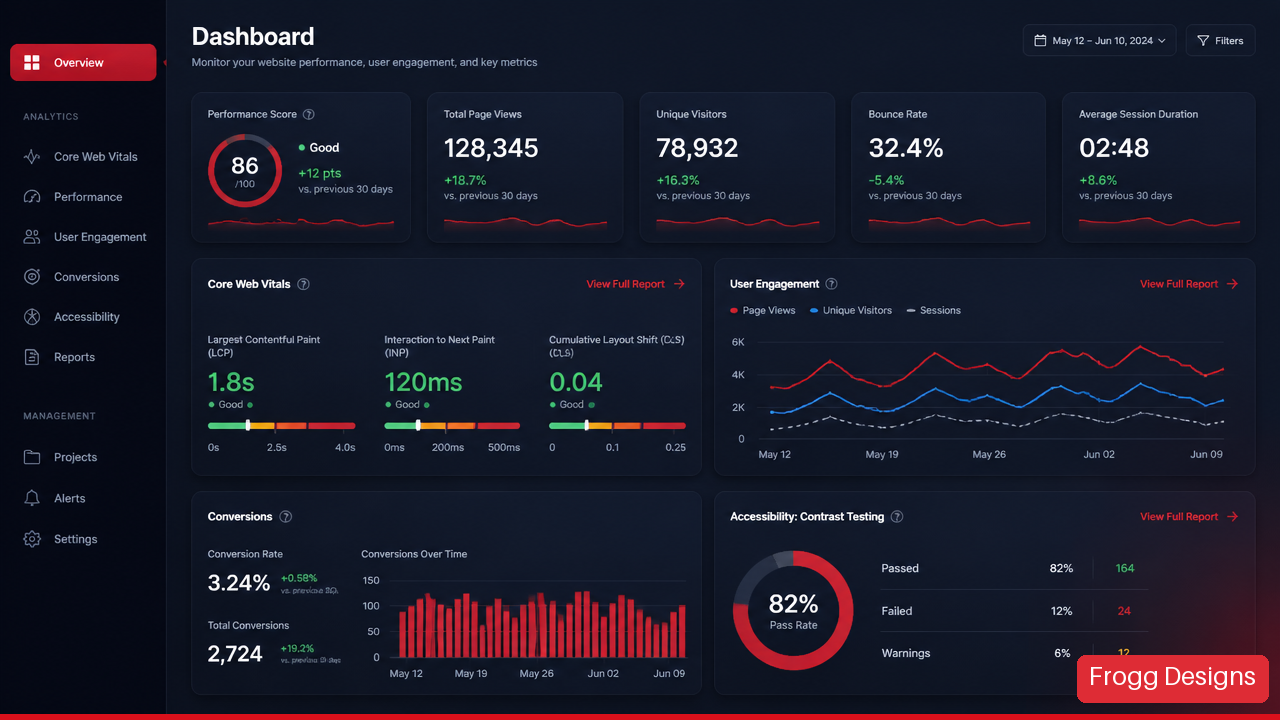
These technical flaws directly impact Google’s Core Web Vitals metrics, measured at the 75th percentile of real-world user visits:
• Largest Contentful Paint (LCP): Must occur within 2.5 seconds or less to deliver a fast perceived loading experience.
• Interaction to Next Paint (INP): Must stay at or below 200 milliseconds to ensure rapid visual feedback during user interactions.
• Cumulative Layout Shift (CLS): Must maintain a score of 0.1 or less to avoid unexpected layout shifts while assets download.
When AI platforms auto-generate uncompressed background graphics, complex animations, and unused script frameworks, your site’s technical metrics suffer. Slow performance frustrates mobile users, drives up bounce rates, and lowers organic rankings. Avoiding these errors is critical to steering clear of 5 common web design mistakes South African businesses make.
Accessibility Failures That Automation Cannot Fix
Ensuring your website is accessible to individuals with visual, auditory, motor, or cognitive disabilities is an essential technical requirement. Automated site builders frequently promise instant accessibility compliance through auto-generated image tags and overlay tools. However, international standards state that AI-generated design can create accessibility failures around structure, contrast, navigation, and alternatives.
Common accessibility breakdowns in AI-generated sites include:
• Inaccurate Image Descriptions: Automated systems generating generic alt text like “image of business meeting” for a technical workflow chart.
• Broken Heading Structures: Skipping heading levels (e.g., jumping from an `
` directly to an `
`) to achieve specific visual font sizes, breaking screen reader navigation trees.
• Insufficient Color Contrast: Selecting pastels or light gray body text on white backgrounds that fail minimum contrast ratios.
• Keyboard Navigation Traps: Interactive pop-ups, modals, or mobile menus that cannot be closed or navigated using only the `Tab` and `Esc` keys.
Over-relying on automated fixes without manual screen reader testing leaves your site vulnerable to compliance issues and isolates a significant portion of your potential audience.
Legal, Compliance, and Trust Vulnerabilities in AI Content
Confabulation, False Claims, and the Erosion of Brand Credibility
Generative language models do not retrieve facts from a validated database in real time; they predict word sequences based on probabilistic patterns. This architectural reality leads to confabulation—presenting completely false or fabricated information with persuasive confidence. The National Institute of Standards and Technology (NIST) highlights that presenting incorrect or fabricated content, false citations, or incorrect operational details is a known risk inherent to generative models.
When published on a commercial site without human verification, confabulated output damages buyer trust. Examples of high-risk errors include:
• Listing specialized services or software integrations your company does not provide.
• Stating incorrect turnaround times, warranties, or refund windows.
• Citing fake statistics, non-existent industry awards, or invalid partner accreditations.
• Publishing inaccurate product specifications that trigger customer disputes and return costs.
POPIA, Consumer Protection, and South African Compliance Realities
For South African organizations, publishing unverified AI copy carries legal and financial risks under national consumer and privacy frameworks.
Under the statutory terms of the Consumer Protection Act, misleading marketing claims on business websites can create consumer-law risk. If an AI generator writes false promises regarding pricing, availability, or operational outcomes, your business remains legally accountable for those representations.
Similarly, compliance with national privacy statutes cannot be automated. Official legislation mandates that under the Protection of Personal Information Act (POPIA), website content and forms that process personal information must comply with lawful processing and safeguards. Automated site generators often insert generic, overseas privacy terms that fail to account for South African information processing mandates, cross-border data transfer rules, or proper consent mechanisms.
Data Privacy Hazards in Chatbots and Automated Forms
Beyond published copy, interactive AI components introduce data privacy vulnerabilities:
• Third-Party Chatbots: Unregulated conversational widgets that capture sensitive customer enquiries and process data on overseas servers without valid consent.
• Unencrypted Form Workflows: Lead forms that capture personal identification details without appropriate encryption or clear retention policies.
• Pasting Sensitive Data into Public Prompts: Employees pasting proprietary client data into public generative platforms to create site summaries, inadvertently exposing personal data.
Reviewing all regulatory policies and customer touchpoints with qualified human personnel is vital to maintaining operational compliance.
Human-Driven AI Workflows: Strategic Quality Control for Businesses
Where Generative Tools Excel in Website Production
Rejecting AI slop does not mean avoiding artificial intelligence entirely. When used intentionally under qualified human management, generative platforms accelerate early stage production without compromising output quality. Staying ahead of essential website design trends of 2023 and modern design practices involves knowing where automation adds value and where human expertise remains mandatory.
Effective uses of AI in web projects include:
• Initial Content Brainstorming: Generating broad topic outlines and exploring alternative phrasing options.
• Information Architecture Drafting: Organizing broad product catalogs into logical navigation categories for review.
• Synthesizing Raw Research: Distilling long customer interview transcripts to identify common audience pain points.
• Developer Assistance: Assisting programmers in writing clean starter code or drafting regex patterns for custom forms.
Essential Human Governance: What Must Never Be Automated
While AI handles routine tasks, strategic brand decisions require human direction. Machines cannot feel brand tone, understand local market dynamics, or take legal responsibility for corporate promises.
┌─────────────────────────────────────────────────────────────────┐
│ HUMAN-LED GOVERNANCE │
├────────────────────────────────┬────────────────────────────────┤
│ Tasks Safe for AI Assistance │ Tasks Requiring Human Control │
├────────────────────────────────┼────────────────────────────────┤
│ • Draft content outlines │ • Market positioning strategy │
│ • Code syntax generation │ • Final brand voice approval │
│ • Alternative visual ideas │ • Fact checking & compliance │
│ • Content summarization │ • Manual UX & contrast tests │
└────────────────────────────────┴────────────────────────────────┘
AI can accelerate execution. It cannot decide what your business should say, what customers need to hear, or why they should choose you over a competitor.
Actionable Quality-Control Framework to Eliminate AI Slop
Before publishing any new web page, landing page, or redesign, use this strategic quality-control process:
- Define Page Goals First: Establish the user intent and target conversion action before writing prompts.
- Enforce Single Search Intent: Assign every page a specific user query and commercial objective.
- Replace Generic Fluff with Proof: Replace generic marketing jargon with concrete figures, local case studies, and real client testimonials.
- Fact-Check All Claims: Verify every statistic, operational claim, pricing quote, and technical specification against internal business records.
- Audit Brand Voice: Strip away repetitive terms like “delve,” “game-changer,” or “innovative solutions.”
- Manual Mobile Testing: Test the site on physical iOS and Android smartphones to confirm layout response, touch targets, and form performance.
- Technical Metrics Audit: Test LCP, INP, and CLS scores using real-world performance tools.
- Human Accessibility Checks: Test site navigation using keyboard control (`Tab` / `Shift+Tab`) and screen reader software.
- Verify Regulatory Copy: Have legal counsel or privacy experts review all privacy policies, POPIA disclaimers, and terms of service.
- Assign Clear Page Ownership: Ensure a named team member reviews, edits, and takes final accountability for every published asset.
Frequently Asked Questions About AI Slop in Website Design
What is AI slop in website design?
AI slop refers to generic, mass-produced digital content and layouts created by automated systems and published without adequate human review, strategic positioning, or quality control. It usually features generic headlines, stock-style visual themes, unsubstantiated claims, and poor information structure.
Why do AI-generated websites feel generic and forgettable?
AI tools generate output by analyzing common patterns across millions of existing sites. Consequently, automated platforms default to consensus layout choices, standard typography, and predictable language, stripping away the unique identity and targeted positioning that make a brand memorable.
Does Google automatically penalize AI-generated website content?
No, search engines do not penalize content simply because it was generated by artificial intelligence. Search policies focus on content quality, usefulness, and user value. However, publishing low-quality, unedited AI content at scale to manipulate search rankings violates spam policies regarding scaled content abuse.
How can unedited AI copy hurt commercial conversion rates?
Unedited AI copy relies on broad marketing jargon rather than addressing specific customer pain points. When high-intent prospective buyers visit a page filled with generic statements, competing call-to-action buttons, and missing trust signals, they leave to find transparent, authoritative competitors.
What are the main legal risks of using unchecked AI website content in South Africa?
In South Africa, false claims, incorrect pricing, or fabricated statistics generated by AI can violate the Consumer Protection Act. Additionally, using automated privacy policies or form scripts that fail to properly handle customer data breaches the Protection of Personal Information Act (POPIA).
Can AI website builders guarantee full accessibility compliance?
No, automated web builders and accessibility overlays cannot ensure complete compliance. While AI tools can assist with basic tasks like flagging missing tags, comprehensive accessibility requires knowledgeable human testing of heading structures, keyboard navigation, dynamic elements, and color contrast.
What is the safest way to use AI during a website redesign?
The safest approach uses AI strictly as an internal assistant for brainstorming, structural outlining, and initial code generation. All customer-facing copy, strategic positioning, visual styling, fact-checking, and compliance reviews must remain under the direct control of experienced human professionals.
How do I evaluate whether my existing website contains AI slop?
Examine your site for vague headlines that apply to any business in your industry, stock imagery that lacks local context, missing performance proof, slow loading times on mobile devices, and unverified marketing copy. If your pages lack specific client outcomes, your site likely suffers from AI slop.
The danger of AI slop isn’t that visitors will identify which automated tool created the website. It’s that they won’t find a convincing reason to trust the business, remember it, or initiate contact. AI can shorten production time, but professional judgment is what turns digital output into a valuable business asset.
Not sure whether your website feels credible or merely complete? Request a professional website review from Frogg Designs.
Sources & References
• Google Search Central — Creating helpful, reliable, people-first content
• Google Search Central — Spam policies for Google web search
• W3C — Web Content Accessibility Guidelines (WCAG) 2.2
• South African Government — Protection of Personal Information Act, 2013
• South African Government — Consumer Protection Act, 2008